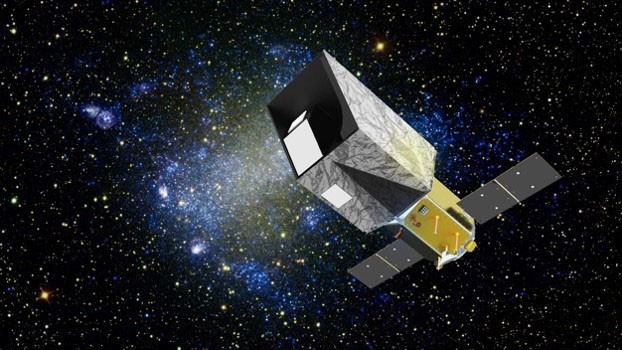
NASA says the UltraViolet EXplorer, or UVEX, passed Key Decision Point C on October 27, 2026, and the agency now commits to a launch by January 2031.
The agency also set a lifecycle cost of $590 million after the telescope passed Key Decision Point C. NASA's UVEX note says the mission was selected in 2024 as a Medium-Class Explorer. It will survey ultraviolet light across the whole sky, for a record of how galaxies and stars change, and it will be able to turn toward an ultraviolet source after a gravitational-wave burst from merging neutron stars. NASA places that survey beside wide surveys from other missions, including the Nancy Grace Roman Space Telescope.
The principal investigator is Fiona Harrison at Caltech in Pasadena, California. NASA names the University of California, Berkeley, the Jet Propulsion Laboratory, Northrop Grumman, and the Space Dynamics Laboratory as the other institutions on the project. The note was posted by Alise Fisher on October 27.
The commitment is a schedule and a cost figure after a technical review. It is not a report that the telescope has already flown.
A positive test result can raise our assessment of the probability of a disease without settling the diagnosis. Two agreeing results can add less information than we expect. Bayesian reasoning shows how to weigh new evidence in diagnosis, in science, and in everyday news reading.
The percentages are shares of particles released at those hours, not the mix in the air people breathe, and the same campaign recorded a different mix in Delhi.
A positive test result can raise our assessment of the probability of a disease without settling the diagnosis. Two agreeing results can add less information than we expect. Bayesian reasoning shows how to weigh new evidence in diagnosis, in science, and in everyday news reading.
UN News reported the findings on 4 November 2026. UNCTAD says the war that shut the Strait of Hormuz in February pushed oil prices up everywhere, but the cost at the pump has been very uneven.
The figure amounts to some 240 million young people aged 11 to 17 who said they did not complete 60 minutes of moderate-to-vigorous physical activity on a single day.