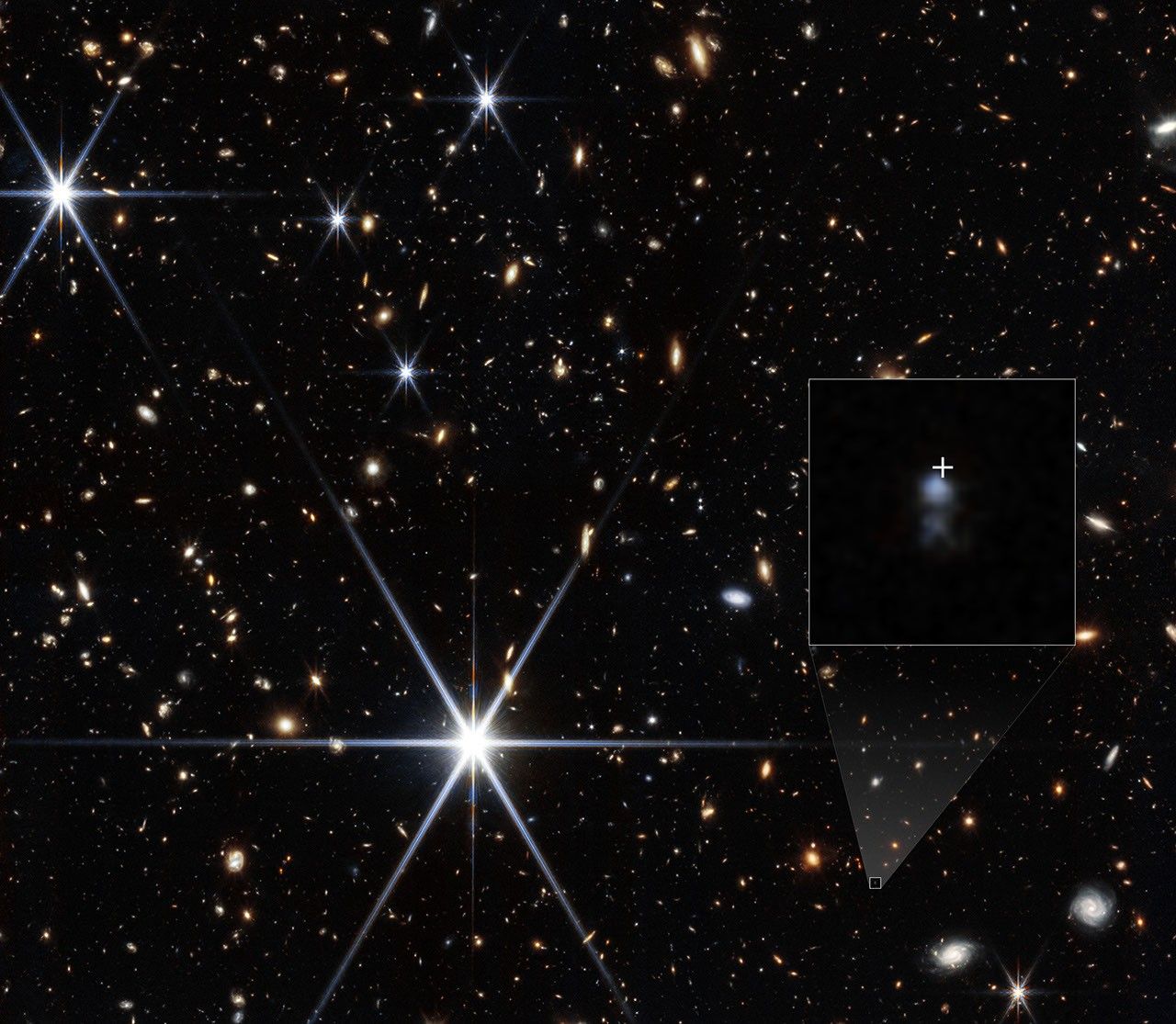
Science published the paper on 8 October 2026 under DOI 10.1126/science.adz2675, with Manisha Caleb as lead author. The paper reports radio observations of FRB 20240304B and near-infrared follow-up that identifies its host galaxy.
The host is a low-mass, clumpy, star-forming galaxy at redshift 2.148 plus or minus 0.0013, corresponding to 3 billion years after the Big Bang. The paper says the burst occurred during the peak of cosmic star formation and probes ionized gas over about 80 percent of cosmic history. The paper says the highly scattered burst emission implies a population of fast radio bursts that current surveys do not detect.
NASA says MeerKAT detected the burst on 4 March 2024, and Webb measured the host redshift with NIRCam and NIRSpec. Manisha Caleb told NASA that astronomers have theories for what produces fast radio bursts but do not have conclusive proof.
This is a single study. It identifies one host galaxy and does not establish the object that produced the burst.
NASA, ESA, CSA, STScI, Themiya Nanayakkara (USYD); image processing: Joseph DePasquale (STScI).
What settles its meaning is not the fact of publication, but the checking that follows: scrutiny of the methods, independent measurements, and a confrontation with other evidence.
A 29 October 2026 Science paper describes the diversion in living infants and in postmortem tissue, and commentators say it is unknown whether the cellular differences last.
A positive test result can raise our assessment of the probability of a disease without settling the diagnosis. Two agreeing results can add less information than we expect. Bayesian reasoning shows how to weigh new evidence in diagnosis, in science, and in everyday news reading.
The percentages are shares of particles released at those hours, not the mix in the air people breathe, and the same campaign recorded a different mix in Delhi.
A positive test result can raise our assessment of the probability of a disease without settling the diagnosis. Two agreeing results can add less information than we expect. Bayesian reasoning shows how to weigh new evidence in diagnosis, in science, and in everyday news reading.
UN News reported the findings on 4 November 2026. UNCTAD says the war that shut the Strait of Hormuz in February pushed oil prices up everywhere, but the cost at the pump has been very uneven.
The figure amounts to some 240 million young people aged 11 to 17 who said they did not complete 60 minutes of moderate-to-vigorous physical activity on a single day.