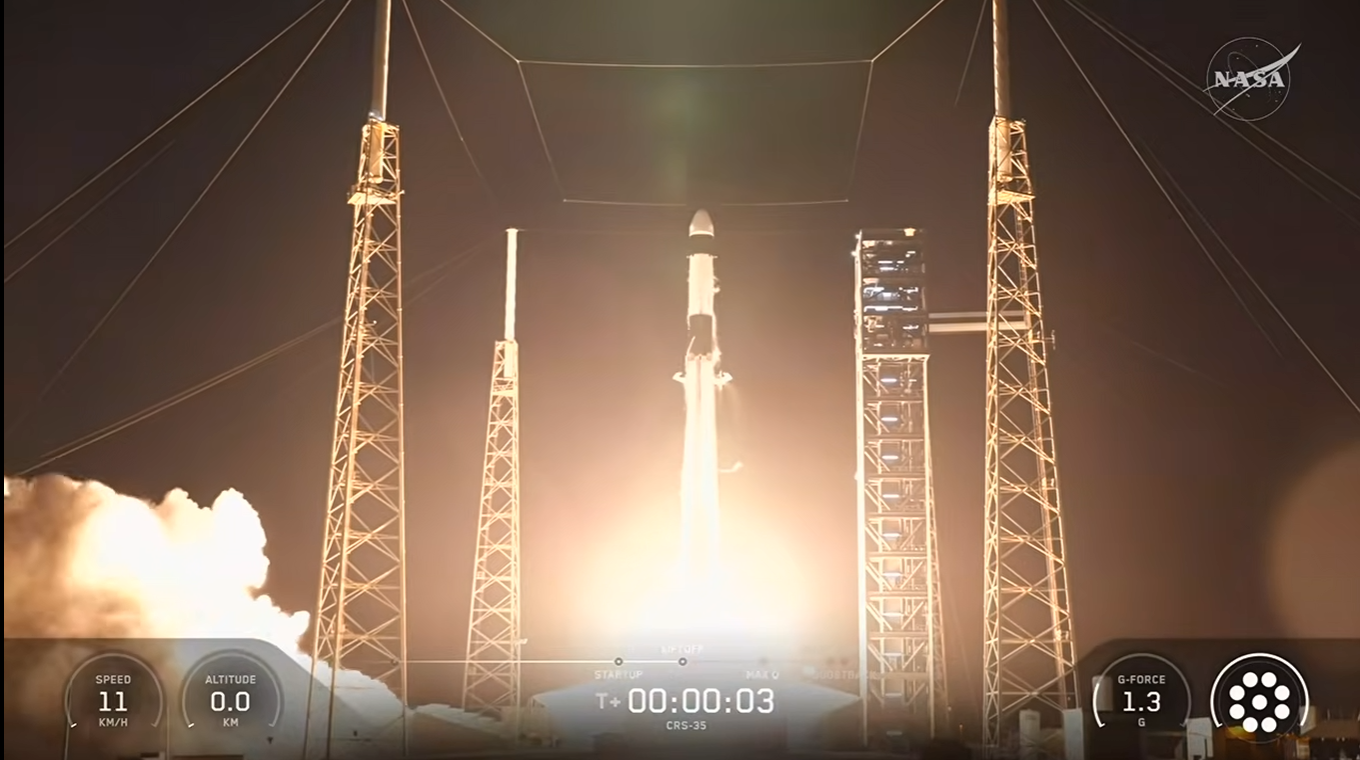
NASA's 35th commercial resupply mission with SpaceX lifted off at 6:33 a.m. Eastern time on Tuesday, October 13, 2026, on a Falcon 9 rocket from Space Launch Complex 40 at Cape Canaveral Space Force Station in Florida. NASA says the rocket carried more than 6,300 pounds of supplies and hardware for the International Space Station.
NASA
Dragon is carrying new experiments, cargo, and the final pair of the station's roll-out solar arrays. NASA says it is scheduled to dock on its own at 11 a.m. Eastern time on Thursday, October 15, at the space-facing port of the Harmony module. Coverage of that docking is set to begin at 9:15 a.m.
NASA says the arrays will complete an upgrade of the station's power system for research, operations, and a controlled deorbit. Astronauts are to install them on spacewalks later this fall.
NASA says the cargo also includes hardware to manufacture artificial retinas in microgravity that could help restore vision, three-dimensional heart tissue models for drug testing on future missions, materials for studying how a new type of glass forms in microgravity, and brain organoids that could uncover treatment targets for Alzheimer's disease, Parkinson's disease, and multiple sclerosis. The release describes what the hardware is for. It does not report a result from any of those experiments.
Dragon is scheduled to stay at the station until mid-November, then return with research and cargo and splash down off the coast of California. The launch is the part NASA reports as completed. The docking time and the return date are still schedules.
A positive test result can raise our assessment of the probability of a disease without settling the diagnosis. Two agreeing results can add less information than we expect. Bayesian reasoning shows how to weigh new evidence in diagnosis, in science, and in everyday news reading.
The percentages are shares of particles released at those hours, not the mix in the air people breathe, and the same campaign recorded a different mix in Delhi.
A positive test result can raise our assessment of the probability of a disease without settling the diagnosis. Two agreeing results can add less information than we expect. Bayesian reasoning shows how to weigh new evidence in diagnosis, in science, and in everyday news reading.
UN News reported the findings on 4 November 2026. UNCTAD says the war that shut the Strait of Hormuz in February pushed oil prices up everywhere, but the cost at the pump has been very uneven.
The figure amounts to some 240 million young people aged 11 to 17 who said they did not complete 60 minutes of moderate-to-vigorous physical activity on a single day.