Opinion · Analysis
Who Really Creates? AI, Copyright, and the Illusion of Easy Answers
As artificial intelligence transforms the creation of books, images, music and inventions, the line between directing a creative process and performing the work becomes increasingly difficult to draw. But does using a more autonomous tool make someone any less of a creator?
In this story
- Copyright still asks whether a person shaped the expression, and the tool used does not answer that question alone.
- Poland's industrial-property statute can vest the right to seek a patent in an employer while the inventors stay the people who supplied the inventive contribution.
- T 0528/25 dismissed the DABUS appeal because the inventor designations were inconsistent, and it fixed no general measure of human contribution.
- Personal authorship, exclusive economic rights, and the mere launch of a generative process remain three different questions.
Copyright law has spent centuries learning to distinguish the creator from the tool, the author from the performer, and the idea from the work. Perhaps the problem does not lie in the technology itself, but in our understanding of agency and of intellectual property.
The piano, the machine, and the person
Imagine a pianist performing a work by Beethoven. In front of the pianist stands an instrument, a complicated mechanical construction that turns the movement of fingers into sound. The piano is not the composer. It holds no copyright in the music, and it makes no claim to the interpretation.
Now replace the pianist with a mechanical device that presses the keys according to a sequence programmed in advance. The resulting performance may sound almost identical. The performer has changed. The character of the work itself has not necessarily changed.
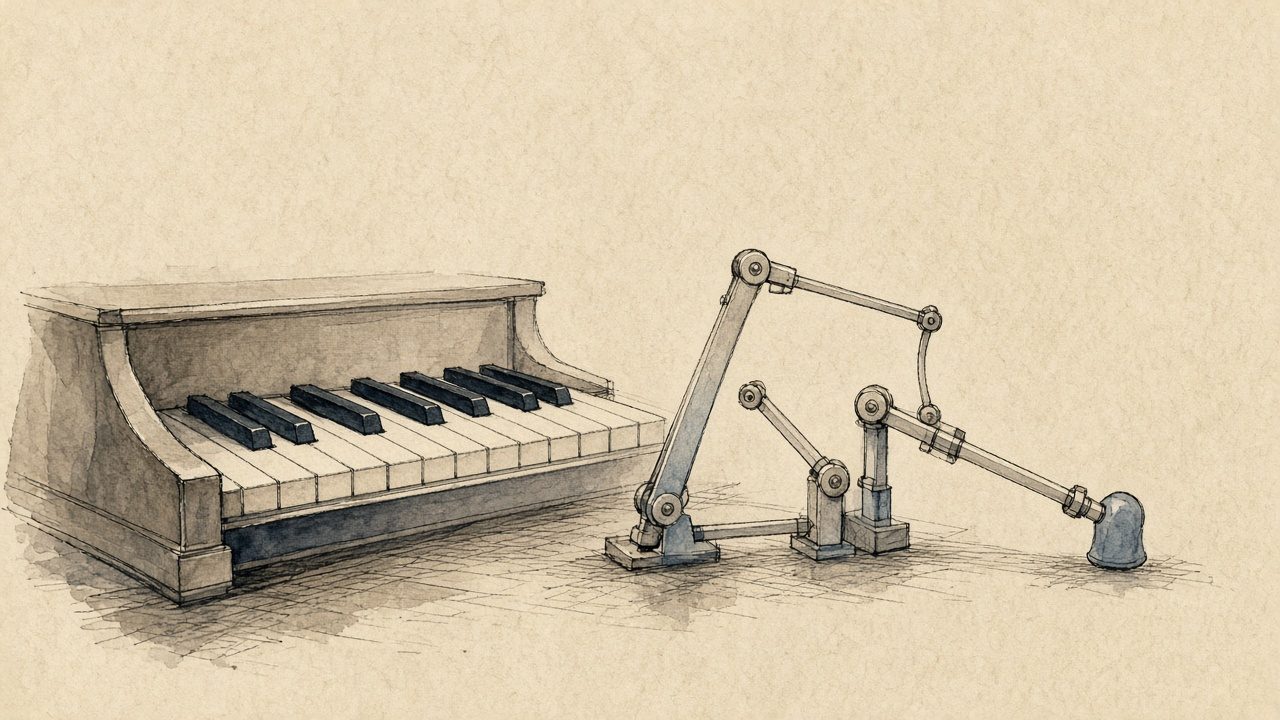
Now reverse the situation.
A person can spend hours pressing the keys of a piano without making any compositional decision that matters. That person can reproduce a sequence as mechanically as a conveyor carries successive objects through a factory.
At the same time, an advanced computer system can analyze harmony, develop motifs, propose variations, and generate compositions that no one has written down before.
It does not follow automatically that the computer has become an author in the legal sense. It does, however, reveal a deeper distinction. The mere fact that a person performs a given act does not yet prove that the act is creative. Likewise, performance of that act by a machine does not decide that the process as a whole lacks creativity.
For a long time we could tell, with relative ease, the tool from the person who creates with it. A brush did not decide the composition of a painting. A printing press did not write books. A text editor did not choose the author's arguments.
Generative artificial intelligence complicates that picture, because the tool may no longer only carry out instructions. It may also shape a substantial part of the result on its own.
That does not mean that all the earlier rules have ceased to apply.
It means that we need a clearer understanding of what those rules are actually about.
Does using AI take authorship away from a person?
Consider a designer of textile patterns.
The first designer draws a pattern by hand and prepares it for production alone. The second builds a mathematical model of an ornament and then programs a machine that produces the material according to rules the designer has worked out.
The third uses a generative system. That designer sets the aesthetic premises, the proportions, the rules of symmetry, the palette, and the technical requirements. The designer then revises the instructions many times, compares the results, and chooses the final design.
Does the third designer stop being a creator only because the tool is more advanced?
It is hard to find a convincing reason to answer yes without examining that designer's actual contribution.
The problem appears when the whole process is reduced to a single word: prompt.
A prompt may contain a simple command: "Draw a sunset." It may also be a fragment of a detailed specification, developed through many iterations, combined with the designer's own materials, precise constraints, and a deliberate process of selection.
Treating the two cases as identical would be an oversimplification.
Not every prompt is an expression of individual creativity. Not every generated result deserves copyright protection. The mere fact that a prompt was used is not enough to establish what role the person played.
Automation of execution is not the same thing as automation of the whole creative process.
That distinction matters especially in photography, design, film, music, and software, fields that have long used tools that carry out a substantial part of the technical work.
A photographer does not steer every photon that strikes the sensor. A photographer does not design every element of the reality being photographed. Even so, choices about the frame, the light, the composition, and the moment the picture is taken can be the essence of the creativity.
In its Painer judgment of 1 December 2011, the Court of Justice of the European Union confirmed the importance of a photographer's free and creative choices for the protection of the work.
Why, then, should we not carry out an analogous analysis for a user of AI?
Photography and image generation are of course not identical processes. An AI system can determine, on its own, elements of expression over which the user does not exercise comparable control.
That is an argument for a closer examination of the creative contribution. It is not an argument for refusing protection automatically.
The corporation, the inventor, and the work order
The issue becomes even more revealing outside the arts.
Imagine a pharmaceutical company. The board decides to develop a new catalyst that will make a defined chemical reaction possible.
It prepares a budget, sets a research aim, hires scientists, and orders the work to begin.
A team of chemists runs experiments, performs calculations, studies compounds, and in the end makes an invention.
Who owns it?
Article 11(3) of the Polish Industrial Property Law provides that the right to obtain a patent for an invention made in the course of duties under an employment relationship, or in the performance of another contract, generally belongs to the employer or the commissioning party, unless the parties have agreed otherwise.
That does not mean that the members of the board have become the inventors. The inventors remain the people who made the actual inventive contribution. The company may, however, obtain the corresponding economic rights.
The law therefore recognizes a situation in which the party that holds rights in the result is not its direct creator.
Now make one change.
Instead of employed chemists, the company uses an autonomous AI system. The board defines the same problem, supplies the resources, and starts the process. The system generates a solution, which is then verified by experiment.
If the solution is technically new, non-obvious, and capable of industrial application, its practical value does not depend on whether a person or a machine worked it out.
The legal assessment of inventorship does take that difference into account.
The European Patent Office requires a person to be named as the inventor. In its February 2026 decision T 0528/25, the Board of Appeal confirmed that AI-assisted inventions are not categorically excluded from patent protection and that a natural person may be designated as inventor where a causal contribution can be attributed to them. However, the appeal itself was dismissed because the inventor designations were inconsistent. The decision did not establish a universal threshold for the required human contribution.
That still does not give a single clear answer for inventions that arise in a wholly autonomous way.
A question then appears that cannot be dismissed with the simple statement that AI is not a legal person.
No industrial machine is a legal subject either. That does not mean that the owner of a business loses rights in products made with machines.
Ownership of a physical product and a patent are, of course, different institutions. A patent does not arise automatically with an invention. It requires specified conditions to be met, and it grants a monopoly that restricts what other parties may do.
The comparison still matters.
Why should replacing a human team with an AI system, by itself, make it impossible to establish appropriate economic protection for the result?
This is not an argument that a corporation should receive a patent for every command it gives a machine. It is an argument that the justification for protection, and the scope of that protection, should be considered apart from a simple division of performers into people and machines.
Does merely starting a process confer rights in its result?
One could propose a seemingly simple principle: rights in the result should belong to the party without whom the result would not have come into being.
Intuitively, that sounds fair.
Without a person's idea, initiative, and action, a particular book, graphic, or computer program would not have been generated.
But the principle has a serious flaw.
Without the maker of the computer, the result might not have come into being either. Without the supplier of electricity, the same is true. Without the development of mathematics, language, semiconductor technology, or the relevant biological conditions, neither the system nor its user would have come into being.
Should every one of those participants in the story hold rights in the generated book?
Of course not.
The mere necessity that certain conditions exist is not a sufficient basis for authorship.
Something further has to be noticed. The resources just listed were not created solely for this particular book.
The maker of a processor did not design its architecture so that a particular novel would come into being. A power station did not produce energy in order to write the novel's ending.
A person who deliberately decides to create a specific work, and who organizes the process leading to its creation, acts differently.
We can therefore distinguish general conditions that make creation possible from purposeful agency directed at a defined result.
Even that does not resolve the whole problem.
A publisher who commissions a book from a writer also purposefully initiates its creation. The publisher does not, for that reason, automatically become its author. Authorship of particular elements of expression may belong to the writer, while the publisher's entitlements may arise from a contract or from the applicable provisions.
It is therefore not enough to ask who started the process.
One must also ask who actually shaped the result, and on what basis particular rights should belong to that party.
How far does agency extend?
It is worth stepping outside the law for a moment and running a thought experiment.
Imagine a hypothetical creator of reality who designed all the laws of physics, the structure of matter, and the conditions that make intelligence possible.
Suppose that this creator runs the system the way a corporation organizes research and development. The creator sets its aims, lays down the rules by which it operates, and from the outset means to keep the rights in everything that arises within it.
Could such a creator claim the rights in every book, painting, and invention that people would later make?
Within a system that establishes those entitlements, perhaps so. If every future result had been deliberately foreseen and built into the original design, the creator's claim to authorship could be even stronger than the claim of a corporate board directing the work of a team of scientists.
That leads to a more fundamental distinction.
The possibility of creating a system, of specifying its future results, or of setting the rules for the use of its outputs does not yet decide whether exclusive rights in those results are justified.
The question is therefore not only who started the process of creation. It is also why the mere act of starting it should confer rights in everything that arises later, especially when the system leads to beings that themselves seem capable of independent creation.
A similar problem appears in a much more ordinary case.
Parents make it possible for a person to come into being and to develop. Teachers pass on knowledge. Society provides language and culture. None of those facts automatically makes the parents, the teachers, or society co-authors of that person's later books.
Bringing into being a subject capable of action does not mean authorship of every result of that subject's later activity.
We can of course consider how far our own decisions are independent of the whole prior history of reality. The law does not have to resolve the metaphysical problem of absolute free will.
It needs criteria that are much more practical.
It should recognize agency within the bounds of decisions, actions, and dependencies that can actually be established.
Otherwise every question about authorship would lead into an infinite chain of causes.
What today's law actually says
Contrary to a frequent belief, current provisions do not say that every use of generative AI automatically takes copyright protection away from a person.
In Poland, article 1 of the Act on Copyright and Related Rights ties protection to creative activity of an individual character. What is protected is the manner of expression, not the idea, the procedure, or the method alone.
In European Union law, an important criterion is the free and creative choices of a person.
In its report of 29 January 2025, the United States Copyright Office confirmed that using AI as a tool does not rule out protection. Creative modifications, composition, arrangement, and other recognizable elements of human expression may be protected.
At the same time, the Office took the view that the mere formulation of prompts, given the way the commonly available systems analyzed in the report operate, generally does not provide sufficient control over the expressive elements of the output.
A quite different solution has long existed in the United Kingdom.
Section 9(3) of the Copyright, Designs and Patents Act 1988 provides a special rule that assigns authorship of computer-generated works to the person who undertook the arrangements necessary for their creation. The government's report of 18 March 2026 says that, where a general-purpose AI system generates output in response to a user prompt, that author will usually be the person who entered the prompt. The report describes a legal tension in the provision: it applies to original works that have no human author, while the test of originality has come to require an author's own intellectual creation. The government proposes to remove that special protection because it lacks evidence of the protection's ongoing economic value. Many consultation responses also warned of mass production of protected content. The proposal is not a repeal. Section 9(3) remains in force.
There are, then, two different directions of thought.
The first concentrates on an identifiable human creative contribution. The second allows the law to assign authorship to the organizer of a computer process, even though the result has no human author in the traditional sense.
Neither model removes every difficulty.
The first may leave some valuable results of autonomous processes without protection. The second may extend exclusivity too far, onto content produced almost without limit.
The present debate is taking place between those two problems.
Creativity, authorship, and ownership are not the same thing
In discussions of AI, these notions are sometimes used as if they were interchangeable.
They should be distinguished as at least three questions.
Creativity concerns the coming into being of new, individual forms and solutions.
Authorship is a legal category that assigns a given result to a creator according to adopted criteria.
Intellectual property, understood here as a set of exclusive rights, determines who may use specified intangible goods and who may restrict use by others.
These are not identical notions.
A person may be the author of a book whose economic copyright a publishing house then acquires. An inventor may make a patentable invention, while the right to obtain a patent belongs to the inventor's employer.
A company may, in turn, lawfully use generated material even though it holds no exclusive copyright in that material.
Not everything that has economic value has to be subject to copyright. Not every benefit from an investment requires the grant of a monopoly.
That is especially important in the case of AI.
We can accept that a person who built a complex generative process has justified economic interests in its outputs, without at the same time treating that person as the personal author of every single item of content.
Nor does this require legal personality to be granted to the machine itself.
The problem then ceases to come down to the question of whether AI can be an author.
It becomes the question of what entitlements should follow from different kinds of human participation in the coming into being of intellectual goods.
The risk of the opposite extreme
Rejecting an automatic refusal of protection does not mean that we should automatically protect every AI result.
Imagine a firm with an enormous computing infrastructure that generates billions of images, melodies, texts, and designs.
If each of those outputs received full exclusive protection only because the firm started the process, we could end up with a mass appropriation of the space of potential creativity.
The firm would not even have to use most of the results.
It could try to build an enormous portfolio of rights that would hinder other parties' independent activity.
Intellectual-property protection that was meant to support creativity and innovation could then begin to limit both.
This is not an argument against every form of protection for AI results. It is an argument against unlimited exclusivity granted without an analysis of the actual contribution, of the value of the protection, and of its social effects.
There is a second problem as well: the rights of earlier creators.
The fact that a person starts a process for generating new material does not mean that the person may lawfully reproduce other people's protected works.
The lawfulness of using material to train systems, possible infringements by the systems' outputs, and the legal protection of the new results have to be examined separately.
Those are three different questions, and they should not be mixed together.
Balance is also necessary because cost, time, and effort are not yet a sufficient justification for a monopoly.
A company may spend a great deal on working out a solution that does not meet the conditions of patentability. An artist may spend years creating material that does not reach the threshold of originality that copyright requires.
Expenditure matters economically, but it cannot replace all the other criteria.
What a more rational law might look like
Perhaps the first step should be to stop treating the technology as the main criterion.
Instead of asking whether a work was made by a person or by AI, one would establish which processes led to its creation and what roles people played in them.
Four principles are worth considering in particular.
First, technological neutrality. Use of a particular tool should not, by itself, decide that protection exists or that it does not. What should matter is the actual character of the creative contribution.
Second, recognition of concrete agency. What should matter is whether a person deliberately shaped the result through a design, instructions, the choice of material, constraints, selection, modifications, or other substantial acts. A general causal connection is not enough, and neither is the mere supply of infrastructure.
Third, separation of authorship from economic rights. If the result of an autonomous process does not meet the requirements of traditional copyright, separate and properly limited instruments of economic protection can be considered. Such a solution would, however, require a showing that it really brings social benefits and does not restrict competition unduly.
Fourth, proportionality of protection. The scope and the duration of rights should match their justification, taking into account the interests of earlier creators, independent authors, and the audience for culture.
One can also imagine a procedure of proof based on the history of the project: documentation of the concept, successive versions, design decisions, and modifications.
The point would not be to require every act to be registered. It would be to create a way of showing a substantial human contribution where that contribution is contested.
In no case should that mean a duty to disclose every confidential instruction, every set of data, or all know-how.
It is also important to preserve the rights of the actual human co-creators. Organizing a project cannot become a pretext for stripping authorship from employees, artists, or scientists.
The most important question has been put badly
The debate on copyright in works made with the use of AI often concentrates on whether a machine can be a creator.
That is an interesting philosophical and legal question, but it is not necessarily the most important one from a social point of view.
Artificial intelligence does not need consciousness, legal personality, or economic interests of its own in order to change, in a fundamental way, how books, films, photographs, computer programs, and inventions come into being.
Nor do we need to decide whether a person has absolutely free will in order to recognize that person's actual participation in a concrete creative process.
The law should operate in a world we are able to observe, and it should base its decisions on criteria that can be applied.
The development of AI shows, meanwhile, that our existing notions do not always capture the increasingly complicated relations among intention, decision, execution, and result.
Not every human act is creativity. Not every act of a machine is merely a mechanical reproduction of an earlier pattern.
Not every investment justifies a monopoly. But not every result of an autonomous process has to be left without any possibility of economic protection.
It is therefore not enough to answer who pressed the key, wrote the code, or started the generator.
One has to understand where, in the whole process, the decisions that shaped the result were made, what their actual effect was, and what rights should follow from them.
It may turn out that the greatest challenge is not to fit artificial intelligence to the existing definitions of a creator.
The challenge is to build a more precise model of agency, authorship, and economic protection, a model that will remain useful when AI systems become much more autonomous than they are now.
The law should not ignore the differences between a person and a machine. It should not, however, treat those differences as the answer to every question.
In the end, the question is not who performed the work. It is who brought a particular value into being, and in what way, and whether granting that party exclusive rights is actually justified.
That distinction may prove to be one of the most important tasks of intellectual-property law in the age of artificial intelligence.
This article is an analysis and an argument. The proposals for reform in it are not a description of the provisions now in force.