The dollar can weaken without a successor
As BRICS develops alternative payment channels and central banks diversify their reserves, the dollar's dominance is being challenged, but no single currency is positioned to replace it.
In this story
- The dollar is losing some of its share of official reserves even as it remains central to foreign-exchange trading and international finance.
- Paragraph 90 records work by the BRICS Payment Task Force on cross-border payments and on settling trade and investment in local currencies, and the declaration says national priorities differ and that there is no single approach for every member.
- The euro has credible institutions and a large financial market, and it does not have one government-bond market as deep as that of the United States.
- The dollar can lose some of that concentration and still have no successor.
The dollar is losing some of its share of official reserves even as it remains central to foreign-exchange trading and international finance.
As BRICS develops alternative payment channels and central banks diversify their reserves, the dollar's dominance is being challenged, but no single currency is positioned to replace it.
Reserve holdings, foreign-exchange trading, and international finance are economically distinct. The International Monetary Fund's reserve count for the second quarter of 2026 is the latest official measure of that reserve role, and it does not by itself describe trade or foreign-exchange turnover. The dollar leads as a unit of account, a means of payment, a borrowing currency, and a reserve asset, and the size of the lead is not the same. In the Fund's COFER brief of 30 September 2026, the dollar's share of official foreign-exchange reserves was 56.70 percent in the second quarter, down from 57.18 percent in the first. The euro was 20.60 percent, up from 20.04 percent. The renminbi was 2.11 percent, up from 1.98 percent. Claims in dollars were largely unchanged. The share fell because holdings in the euro and in several other currencies rose. The Fund said exchange rates that quarter stayed within about 2 percent, so valuation effects were limited, and the move largely reflected other price changes or shifts in portfolios.
The trading market is a separate count. In the Bank for International Settlements survey for April 2025, the dollar was on one side of 89.2 percent of all trades, the euro on one side of 28.9 percent, and the renminbi on one side of 8.5 percent, as the BIS release records it. Because each trade has two currencies, the shares of all currencies sum to 200 percent, aside from rounding. The Federal Reserve's July 2025 note on the dollar states that arithmetic. A turnover share near 90 percent is not a statement that 90 percent of world goods trade is invoiced in dollars.
That Fed note rounds the dollar's share of disclosed official foreign-exchange reserves to about 58 percent in 2024 and a peak of about 72 percent in 2001. The accessible table behind the chart shows 71.5 percent in 2001 and 57.8 percent in 2024, a fall of 13.7 percentage points over 23 years. The figure is the Board's chart of that series, the share of globally disclosed foreign-exchange reserves from 1995 through 2024.
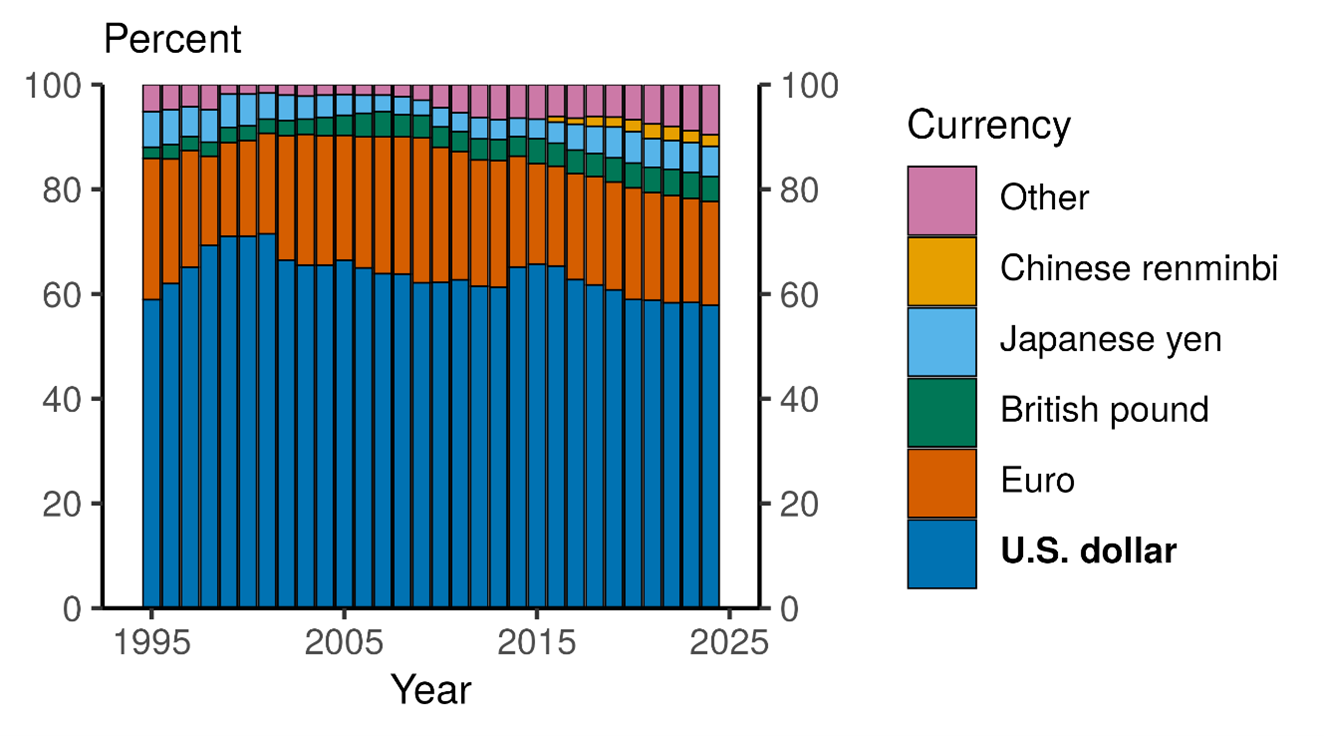
The path is not a straight line, and the decline is not evidence that the dollar must give up its place as the main reserve currency. The 2024 figure and the 2026 COFER figure are not strictly comparable. The European Central Bank's June 2026 report says that in the third quarter of 2025 the Fund stopped leaving an unallocated slice in COFER and imputed it. That change lifted the share of other currencies and revised the euro's share down by about 0.8 percentage point around mid-2025.
The post-war role was set at Bretton Woods in 1944, and in 1971 the Nixon administration suspended gold conversion for official holders. International use of the dollar outlived that link. The accessible companion to that Fed note describes drawings on Federal Reserve swap lines that reached nearly 600 billion dollars around early 2009, about half of that with the European Central Bank, and about 450 billion dollars in the second quarter of 2020, of which about 150 billion dollars went to the European Central Bank and about 200 billion dollars to the Bank of Japan. Those amounts measure use in two stress periods, not the reserve share.
An IMF working paper by Boz and co-authors, issued in September 2025 with invoicing data through 2023, finds that global invoicing shares stayed broadly stable, that the dollar still dominates those invoices, and that the renminbi's share remains modest even where its use has grown. The working paper is a different series from the reserve table.
The expanded group is not a currency union. The New Delhi declaration of 12 to 13 September 2026 does not take that step. The declaration is addressed to the expanded group and, in a separate paragraph, recognizes partner countries. Paragraph 90 records work by the BRICS Payment Task Force on cross-border payments and on settling trade and investment in local currencies, and the declaration says national priorities differ and that there is no single approach for every member. The declaration does not create a common currency, and it is not a roll of members.
India's Press Information Bureau, in its note for the 2026 chairship, lists eleven countries and says Egypt, Ethiopia, Iran, Saudi Arabia, and the UAE became full members in January 2024, with Indonesia joining in January 2025. Egypt's presidency has described Egypt as a full member. Saudi Arabia's own wording is different. Umm Al-Qura, carrying a Saudi Press Agency dispatch of 13 September 2026, said Foreign Minister Prince Faisal bin Farhan attended the New Delhi summit for Crown Prince Mohammed bin Salman and that the Kingdom took part as an invited country. He said the Kingdom looks forward to continued contact with the group. That dispatch does not say Riyadh has rejected the invitation. Reuters reported on 12 September 2026 that Saudi Arabia was invited and has not formally accepted. The Bank of Russia, on a page last updated 20 January 2025, lists Egypt, Iran, the UAE, and Ethiopia from 1 January 2024 and Indonesia from 6 January 2025, and says Saudi Arabia holds the status of an invited country. The Indian list and that wording are not the same fact. A completed accession would still leave the group without a shared central bank, a shared budget, or a rule for uneven shocks.
A purchasing-power share measures real economic size, not the depth of a capital market. The Brazilian presidency's table, drawn from the IMF outlook of April 2025, puts those eleven economies, Saudi Arabia included, at 40.2 percent of world GDP at purchasing-power parity in 2024 and projects 40.7 percent for 2025. Those shares are the April 2025 dataset, not current estimates. The Fund's October 2026 outlook is a newer basis for the group's economic weight. India's chairship note separately puts the same eleven at about 40 percent of global GDP.
A currency and the pipes that carry payment instructions are different objects. A messaging network does not, by itself, finish settlement, supply liquidity, or set an exchange rate. A new route has to win on price, on the cost of holding liquidity, on settlement risk, and on access. The declaration is a program of work, not evidence that a large integrated settlement system is already running.
Apart from that text, the UNIT Foundation describes its unit as a claim on a basket of 40 percent gold and 60 percent currencies linked to BRICS-plus economies, moved on a distributed ledger. That is the foundation's own design. It is not a reserve promise by the members' central banks, and it does not say who checks the assets or who pays if a participant fails.
Gold is a real reserve asset and a weak sole base for modern settlement. The ECB report of June 2026 says gold's share of total official reserves, foreign exchange and gold together, was 27 percent at the end of 2025, above the euro at 15 percent and US Treasuries at 22 percent in that same comparison. The bank says the result was largely a price effect. The gold price rose about 60 percent in 2025. Priced at the end of 2023, gold and the euro were each about 16 percent and Treasuries about 26 percent. Official purchases were about 850 tonnes in 2025, down from more than 1,000 tonnes a year from 2022 through 2024, and that 27 percent uses a wider total than the COFER dollar share, so the two figures do not share a denominator.
The euro has credible institutions and a large financial market, and it does not have one government-bond market as deep as that of the United States. The same ECB report says a larger international role requires deeper and more liquid capital markets in the euro area. The renminbi has gained in trade settlement and in some financing, and it meets capital controls and a thinner pool of renminbi assets outside China. The Reserve Bank of Australia, in Joshua Brown's August 2026 article, says that since 2021 the share of Chinese trade denominated in renminbi has doubled from below 20 percent to around 35 percent. The same article says the renminbi's share of trade invoicing is smaller than its share of settlement, and that little of this is trade that never touches China. Use of China's Cross-Border Interbank Payment System has risen by more than 400 percent since 2020, while the US-based CHIPS system processed more than 20 times that payment volume in 2025. Brown also says the capital account has opened only step by step, so as to limit exchange-rate swings, and that further international use is likely to stay gradual unless that opening goes further.
The Fed note says about 99 percent of stablecoin market capitalization is linked to the dollar.
The issuer's own credibility is the other half. In the Article IV consultation released on 1 April 2026, IMF staff projected general-government gross debt in the United States at 125.8 percent of GDP in 2026 and 141.5 percent in 2031, and the Fund said debt would exceed 140 percent of GDP by 2031. That is a projection, not a report that a dollar crisis has already happened.
Financial sanctions can give some states a reason to build pipes they control. The Fed note says the reserve data it reviewed do not show a notable drop in the dollar's reserve share from that experience.
One reading of this record is three paths, not a dated forecast. Later measurements of the same indicators would strengthen or weaken each path: the dollar's COFER share of reserves, its BIS share of foreign-exchange turnover, its share of trade invoices, its share of international debt, the scale of CIPS beside systems such as CHIPS, and whether the Treasury market continues to function. This desk assigns no probability to any path.
The likelier path over the next decade is a slower spread across several currencies, with the dollar still the main reserve and financing currency and no single successor. A second path, if geopolitical rivalry hardens, is a break into regional networks, the dollar in one area, the euro in another, and the renminbi in a set of trading relationships. A faster loss of the lead is less likely in the near term and cannot be ruled out. It would most likely need several breaks together: a lasting loss of confidence in US institutions, a fiscal or monetary disorder that persists, a malfunction in the Treasury market, and an alternative that is already usable at scale. Nothing in these sources names a threshold for that shift or puts a year on it.
This desk's reading is that the probable change is a long move toward more currencies and more than one set of pipes, with the dollar still first. Over the next five to ten years the dollar is likely to remain the main currency of the system. These sources do not date a later change.
What would weaken this reading is a break, in the same period, across those indicators together, or a non-dollar settlement route that is already cheaper across a large set of corridors. Neither result is what these sources show. The dollar can lose some of that concentration and still have no successor.