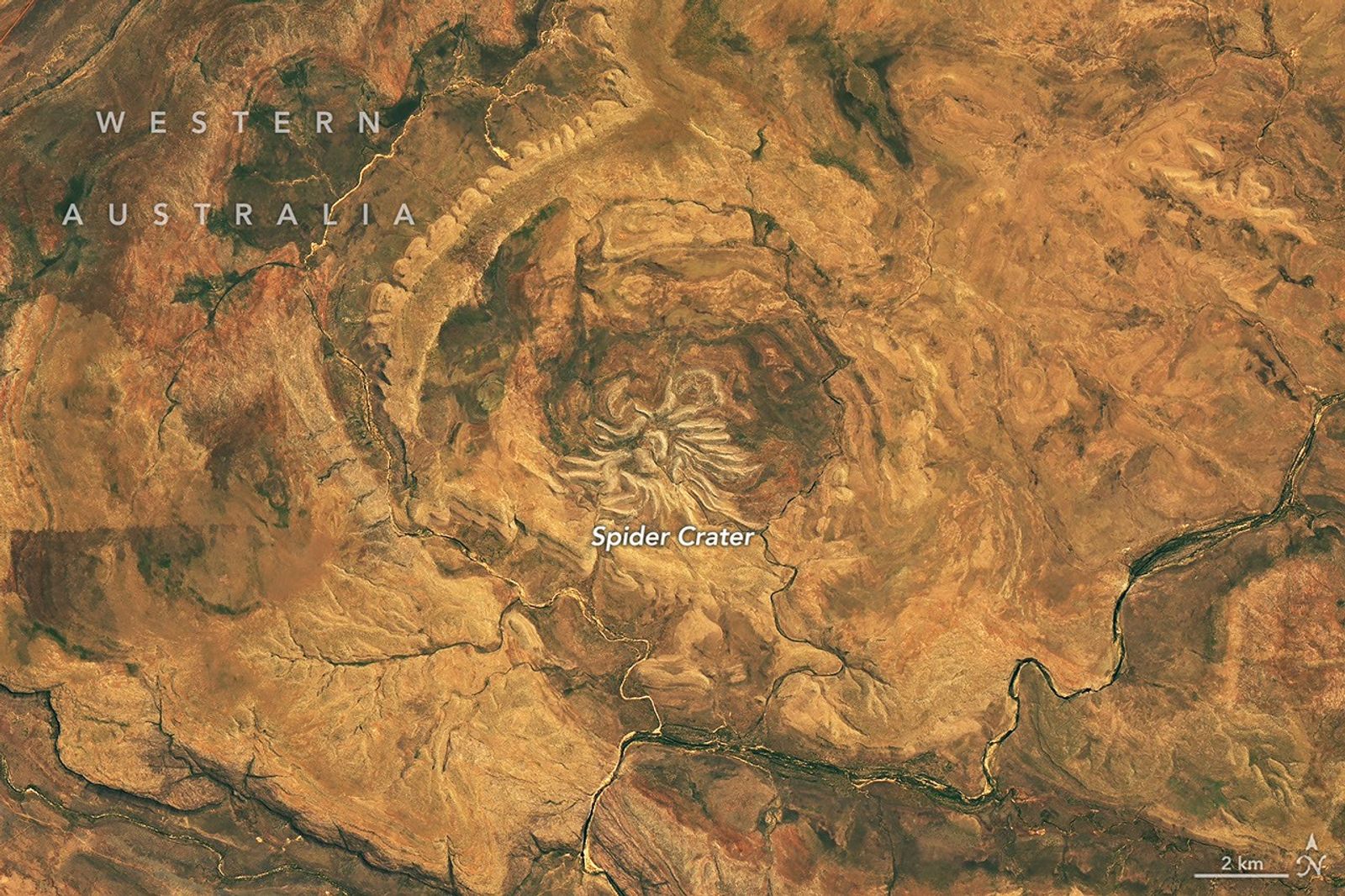
NASA's Earth Observatory published an image on October 13, 2026, of Spider Crater, a meteorite impact structure in the Kimberley region of Western Australia that erosion has been reshaping for hundreds of millions of years.
NASA Earth Observatory image by Michala Garrison, using Landsat data from the U.S. Geological Survey.
The full structure forms an oval about 13 kilometers by 11 kilometers, roughly 8 miles by 7, with a spider-like center near 4 kilometers, about 2.5 miles, across. Geologists cited by the observatory read that central pattern as a central uplift, the crater floor that rose when the ground rebounded from the force of the impact shock. The lighter-colored legs radiating outward are, the observatory says, sandstone ridges that stayed standing once the softer layers around the impact zone eroded away.
The observatory notes that for decades some geologists argued the crater was volcanic. Fieldwork changed that. Researchers found shatter cones, fan-shaped fractures that form only when intense shock waves move through rock, and the observatory says these are common across the crater's central dome. Their presence is what moved the structure from a volcanic candidate to a confirmed impact site.
The observatory says laboratory work on shocked quartz and zircon from the sandstone can help reconstruct the angle of the strike. It says the date of the impact is still unresolved. Estimates from rocks in the region place it between about 900 million and 600 million years ago, in the late Precambrian.
The Guardian account puts the report's current-policy path at 2.8 degrees, with less than 10 percent of glacier ice left in the Rockies, the Alps, Iceland, and Scandinavia, and about 20 to 35 percent left on a 1.5 degree path.
A positive test result can raise our assessment of the probability of a disease without settling the diagnosis. Two agreeing results can add less information than we expect. Bayesian reasoning shows how to weigh new evidence in diagnosis, in science, and in everyday news reading.
The percentages are shares of particles released at those hours, not the mix in the air people breathe, and the same campaign recorded a different mix in Delhi.
A positive test result can raise our assessment of the probability of a disease without settling the diagnosis. Two agreeing results can add less information than we expect. Bayesian reasoning shows how to weigh new evidence in diagnosis, in science, and in everyday news reading.
UN News reported the findings on 4 November 2026. UNCTAD says the war that shut the Strait of Hormuz in February pushed oil prices up everywhere, but the cost at the pump has been very uneven.
The figure amounts to some 240 million young people aged 11 to 17 who said they did not complete 60 minutes of moderate-to-vigorous physical activity on a single day.